
Dear MendMeShop,

My experience with Mendmeshop has been great from the beginning. I hurt my knees last August, and at one point I couldn't even walk. I had tried everything from chiropractic treatments to physical therapy to traditional rest, and nothing really seemed to help a whole lot. One thing that made my knee problems worse was the muscles spasms I was having in my legs. Nothing really helped these, and they sometimes would last for days. So I ordered the Platinum Knee Therapy Kit because I wanted to try the ultrasound. I have been using it for the past couple of months. The number and frequency muscle spasms have greatly lessened, and this has made healing easier. I use the ultrasound daily, and have found that it can provide immediate relief to pain now that I have been using it for awhile. I also use the cold pack when I feel acute pain, and I find it to be really easy to use and really comfortable. The heat pack is good for when my knees are feeling stiff. The lavender ultrasound gel is very cooling and soothing, and I can feel it going deeply into my knees when I use the ultrasound. I have also been extremely happy with the customer service I have received. The staff have always been happy to answer my questions and very prompt in getting back to me. I even received a personal phone call letting me know when an order would be shipped, which I really appreciated. Thank You Very Much Mendmeshop, and I hope that I can continue ordering products from you for a very long time.

Rating: Five Star Rating

Jessica Dunton


More Facts About Achilles Tendonitis:

The achilles tendon does not have a rich blood supply. Blood supply is weakest at a point between 2 and 6 cm above its insertion into the calcaneus (heel).


Ignoring pain in the achilles tendon (ie. "running through the pain") is the biggest cause of chronic achilles tendonitis.


The achilles tendon is the connection between the heel and the most powerful muscle group in the body.


Sudden increases in running and or active sprinting sports can cause achilles tendonitis.


Excessive running up and down hills can aggravate the achilles tendon.


Stiff shoe soles at the ball of the foot will increase achilles tendon strain.


Excessive heel shock absorption can overstretch the achilles tendon.


Tight hamstrings and/or tight calf muscles create excess strain on the achilles tendon.


Therapeutic Ultrasound can speed achilles tendon recovery significantly.


Dear MendMeShop,

Just a note to let you know I'm 100% satisfied with all of the products I've ordered from your company including the Hamstring INFERNO wrap and ultrasound machine.

Rating: Five Star Rating

Mary Ann Michalsky


Tarsal Tunnel Syndrome

Tarsal Tunnel Syndrome (TTS) is a nerve disorder caused by the compression or damage to the posterior tibial nerve. This tendon is located in your tarsal canal, which runs through a small space along the inside of your ankle into the heel and sole of your foot. This condition is slowly progressive and occurs more commonly after 30 - 40 years of age. It causes a lot of pain in your foot, ankle and toes.
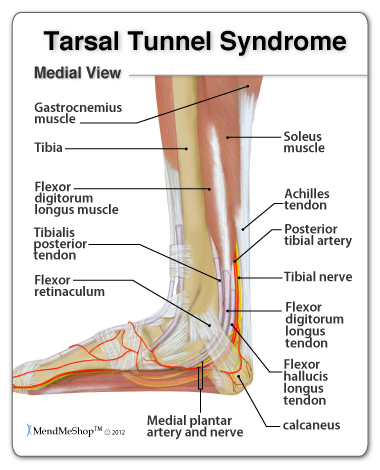
Tarsal Tunnel Syndrome (TTS) causes pain in the foot, ankle, and toes.

Often damage to your posterior tibial nerve in one location affects the overall functioning of your nerve, so you are more at risk of suffering from compression in other areas along the nerve.

The nerve sends signals along its length and also carries its own nutrients, which is necessary for optimal function. Nutrients move along the entire length of your nerve via axoplasms (jelly-like material that fills the cells of the axons). If the flow of these nutrients is blocked, your nerve tissue further from the area of compression does not receive the essential nutrients to fight off injuries, and damage, pain and inflammation will get worse.

Similar conditions and other names for tarsal tunnel syndrome include: tarsal tunnel neuropathy, entrapment neuropathy of the tibial nerve, posterior tibial neuropathy, compression of the tibial nerve, and posterior tibial neuralgia. Tarsal tunnel syndrome (TTS) is similar to carpal tunnel syndrome, which occurs in your wrist, however it is far less common.

Anatomy of the Tarsal Tunnel

The tarsal tunnel is found between the thick, overlying fibrous tissue on one side of your foot and the underlying bones. The flexor retinaculum acts as the top of your tarsal tunnel. It forms a deep, band of fibrous connective tissue that surrounds the muscles and nerves in your lower leg and ankle. The top of the calcaneus (heel bone), the inner wall of the talus (2nd largest tarsal bone that forms the ankle joint connecting the leg bones to the foot bones) and the inner/bottom part of the tibia (shinbone) comprise the bottom of your tarsal tunnel. Your ankle tendons, nerves, arteries and veins pass through the tarsal tunnel to get to the bottom of your foot.

The posterior tibial nerve is found between the posterior tibial muscle, the flexor digitorum longus, and the flexor hallucis longus muscles in your lower leg/ankle. The tibial nerve moves behind the bump on the inside of your ankle (medial malleolus) and through the tarsal tunnel, where it then divides into nerve branches in the sole of your foot.

Causes

Any compression or entrapment of the posterior tibial nerve in the tarsal tunnel can cause tarsal tunnel syndrome. This may occur with:
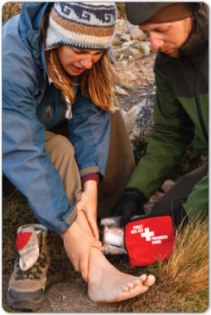
Tarsal Tunnel Syndrome (TTS) can be caused by swelling following an acute ankle sprain.
  • Swelling due to arthritis or diabetes.
  • An ankle sprain or other ankle injury can cause swelling near the tarsal tunnel.
  • Flat feet, or fallen arches, result in an outward tilting of the heel.
  • Varicose veins, a ganglion cyst, bone spur, or other abnormal growth can cause the space in the tarsal tunnel to tighten.
  • Any other lower foot deformity can increase tension in the foot and may instigate the symptoms of TTS.

Symptoms

Although they vary from person to person, most of these symptoms are generally experienced on either the inside of the ankle and/or the bottom of the foot. The most common symptoms noted by those who suffer from Tarsal Tunnel Syndrome are:

  • A tingling, burning, or prickling sensation, also known as paresthesias, in your foot (often in your arch, toe or heal).
  • Vague or sharp pain, near the area where the nerve is squeezed (often in the sole of your foot, near your big toe, or along your nerve); this pain tends to be worse at night.
  • Numbness, a loss of sensation in the area of skin that is supplied by the nerve.
  • Atrophied (weakened) muscles in your inner foot (around the ball or arch of your foot) can affect your gait (the way you walk). You may have a tendency to overpronate (your foot rolls in too much), limp or feel uncoordinated as a result of too much pressure being placed on your foot.

You can feel these symptoms on their own in one location or in various locations across your foot and lower leg. They can be aggravated by overuse of your foot through walking, exercising or prolonged standing. These symptoms will often subside with rest however they will not disappear.

If left untreated, you are at risk of suffering from permanent nerve damage.

Tarsal Tunnel Treatments - What You Can Do!

Cold compression therapy will reduce pain, inflammation and swelling in your ankle to treat tarsal tunnel causes and symptoms. Note that the importance of the cold therapy is very high, though when surveyed, most TTS sufferers never take advantage of this easy treatment step.

AidMyAchilles Customer Reviews

In addition, the use of ultrasound applications over the affected area is recommended as it reduces nerve damage, swelling, inflammation, and scar tissue build up on the posterior tibial nerve within the tarsal tunnel. Blood Flow Stimulation Therapy may be used after acute swelling of the ankle and foot has improved to increase the blood that circulates through the area to speed the healing process. During your therapy be sure to give your ankle the rest it needs to prevent further progression of the tarsal tunnel symptoms and nerve damage.

Cold Compression Therapy

Start treating your tarsal tunnel syndrome by applying cold compression therapy for 10-20 minutes at a time, as needed to reduce pain, inflammation and swelling.

Cold Compression 
Freezie Wrap Therapy reduces the swelling, inflammation and pain of tarsal tunnel syndrome in an easy and convenient way.

The Ankle/Achilles Freezie Wrap® allows you to reduce swelling around the tarsal tunnel and treat your tarsal tunnel syndrome pain in a effective and convenient way. Only the Freezie Wrap® gel pack is charged in the fridge. This means the cooling temperature of the gel pack will not cause cold burns, or cryoburn, on your skin like ice or freezie charged gel packs can. You can also treat yourself for longer periods of time so you get lasting pain relief.

Cold compression therapy works by interrupting and slowing nerve and cell function in the injured area and reducing swelling that can compress the posterior tibial nerve that causes the pain of tarsal tunnel syndrome. This is important because once blood vessels and nerves are blocked or damaged, they can no longer carry the vital nutrients through the posterior tibial nerve and tissue cells begin to break-down. Without cold compression therapy nerve damage continues as the cells do not get the nutrients they need to survive.

By limiting the amount of damage done to your posterior tibial nerve, you also reduce pain and limit the amount of healing that needs to occur. This is a very important step to get rid of tarsal tunnel syndrome faster and with less pain!

Ultrasound Therapy

The long term use of therapeutic ultrasound is common with tarsal tunnel syndrome (TTS), as the application of ultrasound will:

MendMeShop Therapeutic 
Ultrasound treats inflammation and scar tissue that builds on the tarsal tunnel and surrounding nerves.
  • Counteract atrophy in muscles and tendons in your foot and ankle.
  • Increase the elasticity of the tendons that pass through the tarsal tunnel.
  • Soften inelastic scar tissue from injured tendon and muscle fibers as well as any scar tissue that may have developed between the posterior tibial nerve and the tarsal tunnel.
  • Decrease inflammation of tendons and the flexor retinaculum (a fibrous sheath passing through the tarsal tunnel).
  • Administer therapeutic medicines into the body through a process known as phonophoresis.

Ultrasound with phonophoresis is rapidly becoming more popular than ultrasound therapy alone.

MendMeShop Lavender Infusion Gel enhances your ultrasound therapy to give your tarsal tunnel and surrounding tissue the ultimate in scar tissue treatment and improved healing power.

Using the MendMeShop® Lavender Infusion Gel during your ultrasound therapy gives you 2 therapies in 1. You get the benefit of the regenerating sound waves from the ultrasound device itself AND the added bonus of the therapeutic ingredients inside the gel being delivered into the tissue where it is most effective.

Our Lavender Infusion Ultrasound Gel contains the natural essential oils of Bulgarian lavender, peppermint, eucalyptus, and menthol and is exclusively available from MendMeShop®. These ingredients reduce inflammation, relieve pain and improve blood circulation to your ankle (subtalar joint). 1 bottle of MendMeShop® Lavender Infusion Ultrasound Gel comes FREE with every MendMeShop® Ultrasound System so you get unbeatable ultrasound therapy for your sore ankle.

How to Order

It is important to know that therapeutic ultrasound will alleviate TTS symptoms, but to truly treat TTS properly and prevent reoccurrence, an extended treatment term is required - 2 months is not unusual. Treatment length will vary depending on the severity, and there are some cases of TTS that are just too chronic, in which case there are very few treatment options other than invasive surgery. If this is the case for your TTS condition, please make sure you are fully informed about the risks and rewards of TTS corrective surgery. Do not use ultrasound to treat tarsal tunnel syndrome is you suspect the tissue inside the tarsal tunnel is infected.

Blood Flow Stimulation Therapy

Using Blood Flow Stimulation Therapy, or BFST®, will speed your recovery. BFST® increases the amount of blood that flows naturally to your ankle to nourish your tendons, ligaments, nerves and muscles, improving the health and elasticity of the tissues and accelerating the healing process.

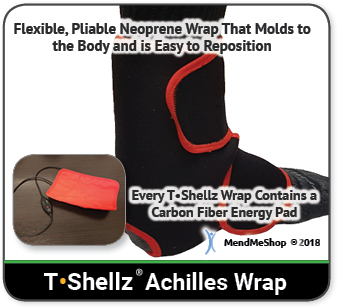
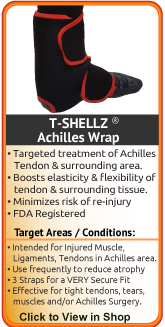
MendMeShop Ankle/Achilles Inferno Wrap speeds the healing and elasticity of your ankle and foot tendons, muscles, nerve, arteries and veins that pass through the Tarsal Tunnel.

An Ankle/Achilles Inferno Wrap® is one of the most helpful tools to treat tarsal tunnel syndrome. Through the absorption of the Energy Web®'s healing energy waves, tissues are safely and gently heated - increasing blood flow within the treated area.

Your body's natural response to this increased temperature is to try to maintain a condition of homeostasis - a balanced environment or state of equilibrium throughout the body. To do this, your body responds with a rapid increase in blood flow to your tarsal tunnel (known as vasodilation), increasing the supply of nutrients to injured cells and flushing out toxins (including lactic acid, commonly found in trigger points) to promote healing.

The Ankle/Achilles Inferno Wrap® is the most effective way to get the non-invasive, non-addictive pain relief of Blood Flow Stimulation Therapy.

Medications

Anti-inflammatory medications can be used to reduce inflammation in the tarsal tunnel and reduce TTS symptoms. However, often this method is usually only somewhat effective for mild cases of TTS and does not heal the damaged tissue. As a result, tarsal tunnel syndrome patients who only use anti-inflammatory medications as treatment find their TTS returns again and again. It is important to heal the tissue surrounding your tarsal tunnel to avoid the symptoms worsening and increasing the chance of surgery being required.

Although pain killers provide some relief they will only mask the symptoms of TTS and are a temporary solution. As well corticosteroids and diuretics that reduce swelling have been found to be temporary pain solutions and do not treat the syndrome at the source.

Lifestyle

Making some changes in your lifestyle can help reduce the symptoms of tarsal tunnel syndrome and reduce the risk of it returning.

  • Staying healthy and treating any conditions that might increase your risk of TTS, like diabetes, arthritis and thyroid disease, can help.
  • If your work, hobbies or daily tasks are causing more strain on your foot try reducing your movements or sit to perform your tasks if possible.
  • Stretching or flexing your foot, knee and legs regularly throughout the day can help maintain more flexible joints and increase the flow of blood to your foot.
Surgery

In more severe cases of tarsal tunnel syndrome, surgery may be required to release the flexor retinaculum to relieve the pressure on the tarsal tunnel. This type of surgery is done without a stay in the hospital and usually only requires a local anesthetic. Unfortunately the results are not guaranteed; symptoms may continue for several months and/or return. As well, recovery time can be a few weeks or months and can disrupt your work, hobbies and daily activities.

We recommend that you consult your doctor and/or physiotherapist before using any of our outstanding products, to make sure they're right for you and your condition.


Achilles Tendon Facts

There are over 250,000 achilles tendon injuries each year in the US.


One quarter of Achilles tendon injuries involve professional medical intervention.


Males experience Achilles injuries more often than females due to higher participation in sports and genetic difference.


Achilles tendonitis accounts for an estimated 11% of running injuries.


3-5% of athletes are forced to leave their sports career due to Achilles tendon overuse injuries that go untreated.


Oral Medications can mask the pain but do not aid in the healing of Achilles tendonitis. Anti-inflammatories, cortisone injections, and pain killers can cause Achilles tendonitis to worsen.


A fully ruptured tendon REQUIRES surgery. It will not heal on its own.


Achilles tendonitis and Achilles tendinitis are the same thing.


Continually using your Achilles tendon while it is injured will lead to a more serious and/or chronic injury.



Contact one of our Mendmeshop Customer Service Advisors for any questions help with ordering and recommended treatment directions

pain relief and injury treatment with ultrasound therapy

Advanced Therapy for torn achilles, ruptured achilles, sprained ankle or other ankle injury

Ankle sprain treatment and pulled achilles treatment without surgery

An effective treatment

Relieve the pain of plantar fasciitis with a cold compress

This universal leg wrap can increase healing rate of a shin, calf, groin, thigh, or hamstring

Freezie Leg wrap for cold compression of the shin, calf, groin, thigh, or hamstring

Contact one of our Mendmeshop Customer Service Advisors for any questions help with ordering and recommended treatment directions