More Facts About Achilles Tendonitis:
The Achilles tendon does not have a rich blood supply. Blood supply is weakest at a point between 2 and 6 cm above its insertion into the calcaneus (heel bone).
Ignoring pain in the Achilles tendon (ie. "running through the pain") is the biggest cause of chronic Achilles tendonitis.
For cyclists, initial Achilles tendon stress is often caused by having a low saddle height. This low saddle height can result in excessive dorsiflexion of the foot, which stresses the Achilles tendon.
The Achilles tendon is the connection between the heel and the most powerful muscle group in the body.
Tennis and soccer players over 40 are the most frequent sufferers of tennis leg (calf muscle strain).
Sudden increases in running and or active sprinting sports can cause Achilles tendonitis.
Excessive running up and down hills can aggravate the Achilles tendon.
Stiff shoe soles at the ball of the foot will increase Achilles tendon strain.
Excessive heel shock absorption can overstretch the Achilles tendon.
Tight hamstrings and/or tight calf muscles create excess strain on the Achilles tendon.
For triatheletes, the most common cause of injuries to the Achilles tendon is overpronation, inflexibility, or lack of strength.
Immobility, due to an Achilles injury, may result in a contracted Achilles tendon and an increased amount of scar tissue.
|
Achilles Tendinopathy Diagnosis
Diagnosing an Achilles Tendon Injury
A physical exam or with diagnostic tests. To help your doctor achieve a proper diagnosis, he/she will begin with a medical history about you, your current condition and symptoms, the intensity of your pain, the duration of your symptoms and the limitations you are experiencing. Details about what causing the problem, when it started, and whether or not you have ever had treatments (for this or a similar condition in the past) are very helpful in assessing your injury.
Your doctor will visually assess and palpate (feel) the bones and soft tissue in and around both of your Achilles tendons to evaluate symmetry and spot any differences. Such as inflammation, swelling, bone deformity, scar tissue build up, and a weakened tendon. He/she will press on the injured tendon to test for tenderness, tough nodes of scar tissue, and jelly-like sections on the tendon. He/she will probably ask you to push down with the ball of your foot and toes (plantarflexing) to evaluate the flexibility, alignment, range of motion and pain level.
Common Diagnostic Tests for the Achilles Tendon
Diagnostic testing to obtain more detailed information, and assess the amount and/or type of damage done to your Achilles tendon. There are a variety of different tests available to help them analyze the situation; however the recommendation will be dependent on your injury.
The Thompson Test is a common physical exam that doctors use to determine if an Achilles tendon has ruptured.
This test involves the patient lying face down on the exam table with knees at a 90 degree angle. The doctor squeezes the calf muscles of the injured leg. If the foot flexes downward (like trying to point your toes) the Achilles tendon is not torn. If the Achilles tendon is torn, the foot does not move.
X-rays don't show much relative to tendons and other soft tissue but it will provide an image of the overall bone structure of your ankle. It is helpful in identifying bone spurs, calcifications within the tendon, fractures or degeneration of the heel bone.
CAT or CT scans can be used to provide a 3-dimensional assessment of the bones and soft tissues in and around your Achilles tendon and may be used to identify a tendon tear.
MRIs (magnetic resonance imaging) will provide more detailed information and will help to evaluate the Achilles tendon damage. An MRI can diagnose tendinosis, tissue damage and tears, and/or other associated conditions.
The type of test recommended will depend on your symptoms and the opinion of your medical professional.
Treating an Achilles Tendon Injury
Your doctor will give advice to use conservative treatments before even suggesting surgery. It is generally understood by doctors and surgeons, that surgery will introduce more scar tissue into the any already damaged tissue. This added scar tissue will be problematic, requiring more PT and conservative treatment options post-surgery. If not dealt with properly, your tendonitis injury could end up in worse condition than before the surgery! This is why surgery is only performed as a last resort.
Most doctors, surgeons and orthopedic specialists will recommend conservative treatment methods for Achilles Tendon injuries before even considering surgery. Some conservative treatment methods recommended include:
- Rest - This is important for initial recovery for both Midpoint and Insertional Achilles Tendonitis; rest and elevation will help reduce pain, swelling and inflammation in the early stages of injury. This can be difficult when you have to carry on with daily activities, but resting and elevating your foot whenever you can is recommended. During your recovery you will probably have to modify or avoid the activities that put stress on your Achilles tendon until your pain and inflammation settles. Too much rest can also be harmful to achilles injuries because ankle joint immobility can actually cause stiffening in the joint. This is why rest should be used when reducing initial pain and swelling, but should not be considered for more long-term conservative treatment.
 - Avoid Activities that Caused Your Injury - While resting your injury it's also important to avoid all activities that may have caused your tissue damage (especially any repetitive movement). Continuing on with regular activities can increase the severity of your injury, turning a mild to moderate case of tendon damage into a downward spiral of worsening damage that may eventually severely impact your life. Also, trying to 'work around' your injury will eventually give rise to over-compensation injuries in other areas of your body.
- Use a Cold Compress or Ice Pack - Cold is very effective at reducing pain and inflammation - use at the onset of the injury and during flareups.
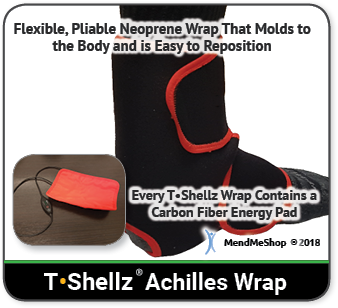
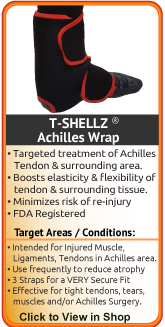
- Use an Achilles TShellz Wrap® (Circulatory Boost device) Once The Swelling is Down - You can use your own blood flow to maximize your rehabilitation, maintain healthy blood flow to your achilles and heel, decrease recovery time, reduce re-injury risk, and boost the bodys' healing rate. Promoting blood flow to the injury using a warming treatment will help to minimize the growth of scar tissue and increase flexibility. This is why we recommend TShellz Wrap before undergoing activity - an increase in flexibility should help reduce risk of further injury while also assisting in the battle against atrophy.
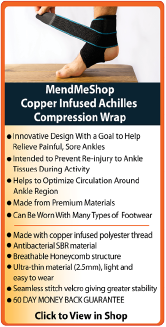
- Use an Achilles Support Wrap - to increase comfort and prevent further damage you may want to use a ankle support sleeve or brace to help support the area, reduce risk of further injury and reduce stress on the injured tissue. Some of these are also designed for heat retention to prevent further strain. They can be used until your injury is gone or during active sports for additional stability. Note that these should not be worn at all times, as they can limit muscle development, cut off circulation and impede healing of muscle tissue.
- Avoid Over Compensating for your Injury on your "'Healthy' (Non-Injured) Side - Many people will start limping or carrying objects with their opposite arm to compensate for their tendon injury. Our bodies can adapt easily to any changes, including a tendonitis injury. This quick adaptation could mean that you're already compensating for your injury without even knowing it!
When you compensate for your injury by using your opposite ('healthy') arm, leg, shoulder, knee, foot, etc. - then you are putting more weight and pressure on that side of your body. In many cases, your dominant side was injured (if you're right-handed this would be your right side) so your weaker side is trying to pick up the slack! The pain, stiffness, swelling and inflammation you then get on your 'healthy' side is something referred to as 'over-compensation pain'. Over-compensating for your injury can lead to other injuries and so that's why over compensation should be avoided at all costs OR treated with the same conservative treatment methods as your tendon injury.
- Rehabilitative Stretching under supervision of a PT or doctor. The intent of this is to provide you with increased range of motion, pain relief and strengthening of the surrounding tissue of the joint. Doctors or surgeons typically won't perform a surgery until they feel that their patient has put effort into treating their injury with conservative treatment methods. This may include up to 4 to 6 months of visits to a PT clinic. If you haven't experienced any improvement in your condition during that time then surgery may be considered. Agressive PT approaches may focus on forced or manual manipulation of the achilles - this means your physical therapists will be trying to move your achilles past the point of comfort as they strive to increase range of motion and prevent further atrophy. This can be painful and end up making your injury worse if not done correctly. (reference: 1)
- Stretching - Stretching your joint in PT and at home will help you to regain your range of motion much faster than not stretching at all. Stretching in many ways is key maintaining good Range of Motion (ROM) in your joint, and stretching can be made much easier with use of a TShellz Wrap® before to warm up soft tissue, and a Cold Compress or Ice Pack treatment after to prevent any return of swelling and inflammation.
Learn More About Achilles Injuries & TreatmentsI want to learn more about Achilles Surgery & Post-Surgery Recovery I want to learn more about Circulation Boost I want to learn more about Ice & Heat: Which Is Better For The Achilles? I want to learn more about Stretching for the Achilles
FREE SHIPPING ON ALL PRODUCTS CURRENTLY ENABLED
60 DAY TRIAL PERIOD
During your recovery, you will probably have to modify and/or eliminate any activities that cause pain or discomfort at the location of your soft tissue injury until the pain and inflammation settle. The more diligent you are with your treatment and rehabilitation, the faster you will see successful results!
|

Achilles Tendon Facts
There are over 250,000 achilles tendon injuries each year in the US.
Achilles tendon ruptures are common in people between the ages of 30 and 50.
In runners, too rapid an increase in mileage, hill training without proper strengthening, and recent or inadequate changes to running gear can cause injuries to the Achilles tendon.
Achilles tendonitis accounts for an estimated 11% of running injuries.
3-5% of athletes are forced to leave their sports career due to Achilles tendon overuse injuries that go untreated.
Medications mask the pain but do very little in the healing of Achilles tendonitis.
A fully ruptured tendon REQUIRES surgery. It will not heal on its own.
Achilles tendonitis and Achilles tendinitis are the same thing.
Continually using your Achilles tendon while it is injured will lead to a more serious and/or chronic injury.





|